
A Hut at the Edge of Everything
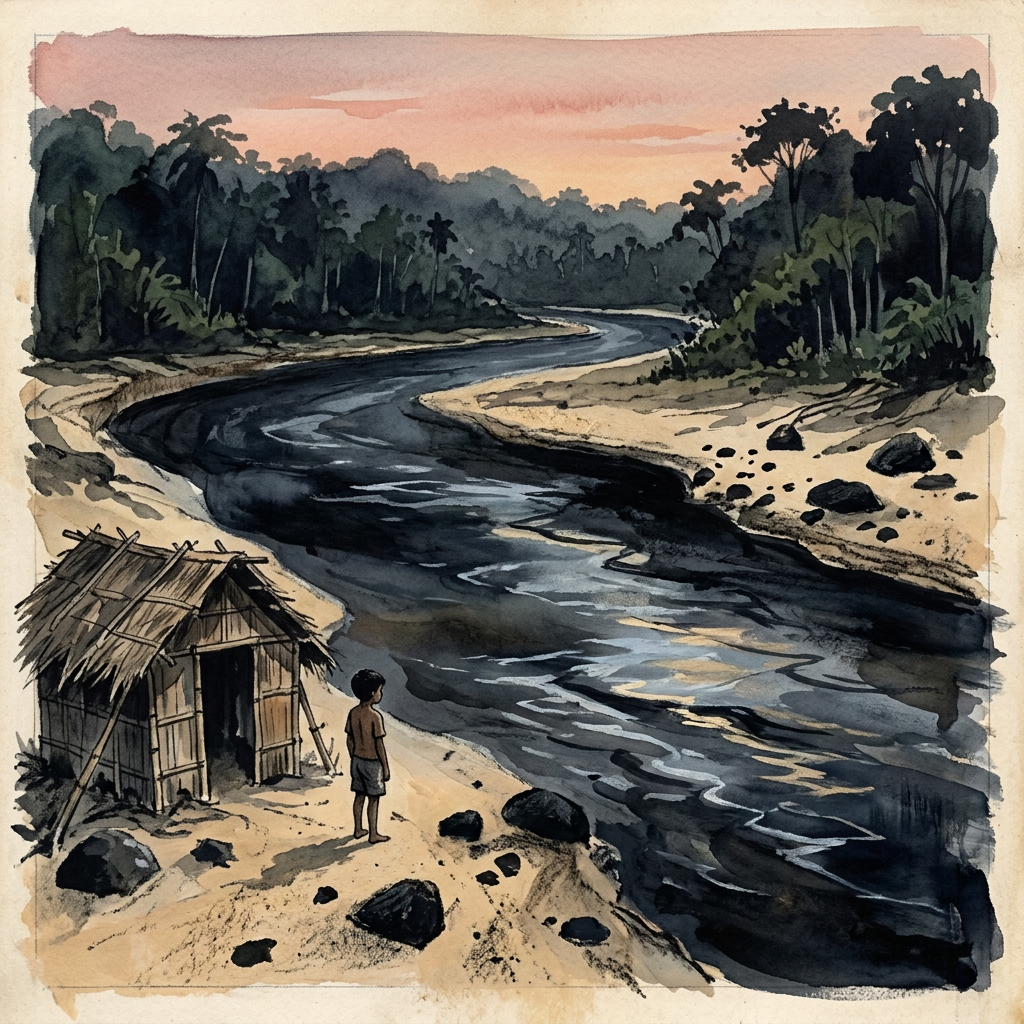
Suleiman lived on the river’s sandy banks with his father, Karim. Their hut was a fragile thing—bamboo poles lashed together, mats for walls, a thatched roof that looked from a distance like a dune dissolving into the surrounding sand. It stood forlorn at the edge of the forest, where the river crept out, in a no‑man’s land between village, forest, and water.
By day, the place was lonely; by night, it was desolate. No one ventured there except the father and son duo. Even the wild boars from the forest avoided the hut, for nothing grew in the sandy soil around it. During the monsoon, the river claimed their home, swallowing it whole, forcing them to retreat to the neighbouring village until the waters receded. Then they returned, resilient as ever, to begin again.
Their livelihood was charcoal. Karim—known as Kari Karim because kari means charcoal in Malayalam—made it from driftwood or fallen forest tree branches. Whenever he could collect enough logs, he would stack them tightly in a crude choola furnace for two or three days, letting the fire smoulder until the wood turned into black lumps of fuel. Suleiman’s job was to collect the charcoal once it was ready, sack it, and sell it to tea shops in the market.
Samovars and Steam
Those tea shops were alive with copper samovars at their entrances, puffing steam like miniature locomotives. To us children, they looked ready to chug away. For the customers, their urgent hissing was an invitation to hurry for tea. Suleiman’s charcoal kept their bellies burning, their water boiling, and their tea-pouring rhythm unbroken. Without him and his father, the market’s heartbeat would have faltered.
Karim, though poor and illiterate, wanted his son educated. That was how Suleiman came to our school and into my class. He was taller, thinner, and older than most of us, and awkward in the strange new world of lessons and blackboards. Every subject was a struggle, except arithmetic. Numbers made sense to him—perhaps because he handled coins and sums in the tea shops.
On days when the choola was opened, Suleiman missed school. He had to sell the charcoal and buy rice and other provisions to survive. Their meals were simple: sweetened black tea and rice gruel with dried fish when fortune allowed. Yet he never spoke of hardship. He carried himself with quiet pride, never asking for pity.
Most evenings, he walked with a few friends and me after school. Our farm lay along the road to his hut, so we often shared the path. As we walked, he spoke of his solitary life by the river, of the constant struggle to keep his clothes clean while working amid charcoal dust. Yet, in class, he always appeared neat and composed—his quiet determination seemed to insist that he belonged among us.
The Silence After
Once I walked with him all the way up to his hut. It was smaller than I had imagined, almost swallowed by the sand. From there, the forest loomed on three sides, the river on the fourth. The silence was immense, broken only by the crackle of firewood or a bird’s cry as it flew over. I understood then the loneliness he spoke of. Yet Suleiman was never without hope. He dreamed of opening his own tea shop one day, with a samovar at the entrance, serving tea to customers while his father rested in comfort.
For two years, he came faithfully to school. Then Karim fell ill and was too weak to work. One day, Suleiman and his father left their hut by the riverbank, and they never returned.
I never saw Suleiman again. Did he succeed in his dream? Did he stand behind a steaming samovar in some town, laughing with customers, proud of the life he built? I do not know. But I hope so. In my memory, he remains the boy who carried sacks of charcoal, walked with me on village roads, and dreamed of a brighter future.
7 responses to “The Boy by the River”
Yes, I wish and pray that Suleiman ‘sahi salamat hai’!
I wish and pray that Suleiman ‘sahi salamat hai’!
Thank you for being moved by Suleiman’s story. 🙏I too hope and pray that he is safe and well.
Very well written. Thank you for sharing.
Thank you! I am happy to know that you liked the post.
A touching tale simply told ! I liked that the end was left as if unsaid ….. optimism, & good wishes for Suleiman can at least let me nurture the hope that he made good of his life !
Thank you! Iam glad that the unsaid ending resonated with you. Hope is a good ending, always!