Ghosts, gods, and the grain fields.
🌾 The Harbinger of the Harvest
Naadi came home every year, almost unfailingly, when the paddy fields ripened and bent low with grain. It was always the season of Chingam, just before Onam, when the air itself seemed to carry the fragrance of harvest. Where he came from, I never knew—only that it was “far away.” To my six‑year‑old mind, “far away” was a magical place, a land beyond rivers and forests, where stories were born and carried on the shoulders of wanderers like him.
Naadi was a Cheruman, descended from tribes who had lived in the northern jungles of Kerala for centuries, long before the forests gave way to villages and fields. He was not just a worker who bent his back to the harvest; he was a keeper of memory, a storehouse of songs and tales. And to me, he was the most precious visitor of childhood—the man who arrived with the scent of paddy and the gift of stories.
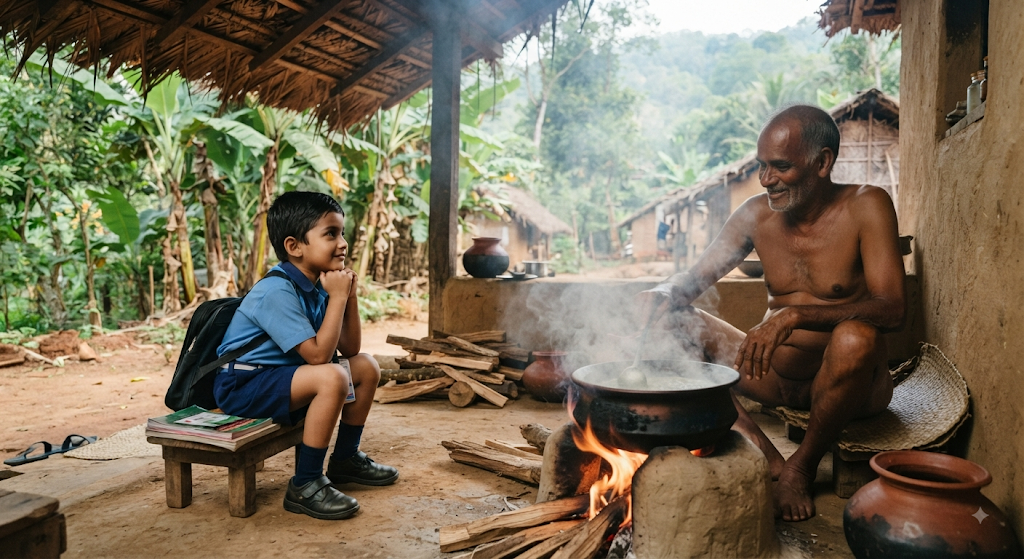
He stayed in a temporary thatched shed near our home, a humble shelter that seemed to belong to another age. Outside, he built his viragu aduppu—three stones arranged in a triangle, cradling his blackened kanji pot. That was his kitchen, his hearth, his world. Each evening, after the day’s toil, he bathed in the stream that ran beside the fields, its waters carrying away the dust of harvest. Then he returned, lit his firewood, and waited for kanji, the rice gruel, to boil.
In those waiting hours, magic unfolded. As the kanji bubbled and the firewood crackled, Naadi sang. His voice was low, almost hypnotic, weaving ballads of Malabar warriors. His favourite was Attummanammel Unniyarcha—the legendary woman warrior, beautiful and fierce, who fought with sword and valour. In his monotone chants, punctuated by the hiss of boiling rice and the crackle of the firewood, Unniyarcha came alive. I saw her eyes flash, her blade gleam, and her son, Aromalunni, stand beside her. I believed Naadi was of their bloodline, a descendant of heroes. And each night, I promised myself that one day I would learn Kalarippayattu, like them, fight injustice, and carve my own legend.
🔥 As the Firewood Crackles, the Tales Awaken
But Naadi’s world was not only of warriors. He spoke of jungle gods, Bhoothams, Odiyans, and Chathans. His stories painted the forest as a place of mystery and menace. Odiyans, he warned, were the most dangerous—shape‑shifters who prowled as cats or dogs, waiting to harm women and children. After hearing him, I eyed every stray animal with suspicion, half‑convinced it might be an Odiyan in disguise.
Bhoothams were hoarders, greedy for gold and children alike. They stole little ones from their mothers, hiding them in caves deep in the jungle. I listened wide‑eyed, clutching my own safety in the folds of his words. Chathans, though mischievous, were kinder. With the right mantras, they could protect you, even bring wealth. I begged Naadi to teach me those mantras, but he laughed softly and said I was too young. “Eight years,” he promised, “and you will be ready.” Each year, I renewed my plea, and each year he reassured me that my time was coming.
The nights with Naadi were a theatre of imagination. Kings, warriors, gods, birds, beasts, and ghosts mingled freely in his tales. They did not always live happily, but they lived vividly, and through his voice, they lived in me.
🌸 Scents That Guard Childhood
I cannot recall Naadi’s face now—it has blurred with time. But I can still smell him. The scent of ripened paddy clung to his skin; the fragrance of boiling kanji rose from his pot; the sharp sting of kanthari mulaku accompanied his meals; and the smoky aroma of damp firewood lingered in the air. These scents are the true relics of my childhood, inseparable from the stories he told.
Naadi came faithfully until I turned eight. Then he stopped. The elders said he was too ill to work, or perhaps he had gone to join his jungle gods. I never knew. But I waited, secretly, year after year, hoping he would return, hoping he would teach me those mantras that would make me a manthravadi, strong enough to silence my school bullies and brave enough to walk with Unniyarcha.
He never came back. Yet even now, when the scent of boiling rice or burning firewood drifts through the air, I feel his presence. Naadi lives on in those smells, in those stories, in the twilight of memory. And in that lingering fragrance, I am once again a child—listening, believing, dreaming.