
A Corner of Childhood
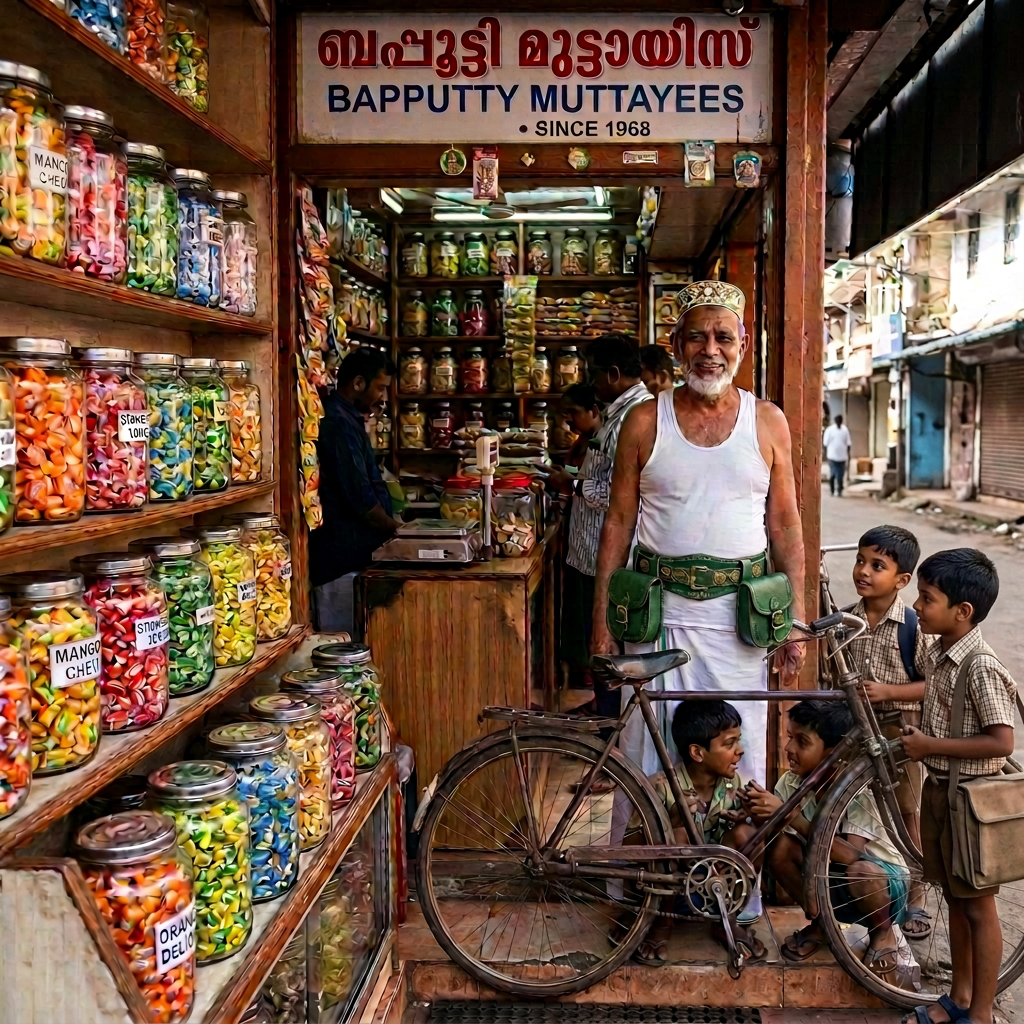
Bapputtykka, or Ikka, as we fondly called him, was a middle-aged man, friendly and helpful. He looked bright in his skull cap, white banian, and white dhoti, which was held firmly in place with a bright green belt. The green belt not only broke the monotony of his all-white attire but also served as a mobile piggy bank, with two pouches stitched on either side where he kept coins and currency notes. His shop in an old building at the western end of the village market was a favourite spot and the meeting ground for the village boys for two reasons – toffees and bicycles.
At the entrance, rows of glass jars gleamed like jewels, each brimming with muttayees—round, square, bird‑shaped, fruit‑shaped, in dazzling reds, yellows, greens, and chocolates. Those toffees, locally known as ‘muttayees’, were a never-ending temptation for us. Whatever small change we managed to save, we promptly put it into Ikka’s pouches in exchange for some of his ‘muttayees’. Though we had a huge demand for his toffees, he always kept those jars full. That was because ‘Ayappa’s Muttayee’ van used to make weekly trips from the nearby town to replenish the stocks. In short, he never ran out of muttayees; what was in short supply was the cash to buy them.
But a few fortunate school friends always had extra coins and bought sweets as and when they wanted. Moosa, a classmate and friend, was one such ‘cash-rich’ guy and Ikka’s most favoured customer. Moosa bought toffees daily and kept a few extra pieces in his pocket, which he effectively used as bait for a variety of purposes. He was least interested in studies but managed to get his homework done by bribing others with sweets. He also had a few faithful friends who assisted him during the exams in anticipation of the ‘sweet’ rewards. Many wanted to become friends with Moosa. Boys fought with each other over doing Moosa’s homework or helping him with any other schoolwork he needed help with. Moosa eventually earned the nickname ‘Muttayee Moosa’ and became a school celebrity for being a sweet guy, quite literally.
The Barter Deal
For the rest of us, getting small change to buy ‘muttayees’ was always a big problem because our parents never encouraged such habits, except on rare occasions like festival days, school anniversaries, etc., which meant only a few times a year. Because this arrangement was inadequate, we had to find other ways to earn pocket money to buy sweets. A major source of income, especially during the summer months, was the cashew nuts. Cashew plants were plentiful in our village and grew almost everywhere – small plantations in certain places and many solitary trees scattered throughout. Ripe fruits with nuts jutting out were a common sight in summer, and the nuts were as good as money. A pocketful of nuts gave us enough money to buy a handful of sweets from Ikka, who was more than willing to barter with us – take the nuts and give the sweets.
Besides picking nuts from the trees, there was another way to collect them: a game the village boys played. Here, the nuts are pooled from each player and are thrown from a distance into a small hole dug in the ground. Every player gets their chance to throw. After a few rounds, whoever places the most nuts in the hole wins. He walks away with the extra nuts, and those who didn’t do well go away ‘nutless’! The winner can keep the nuts or go to Ikka’s shop for sweets in exchange for his nuts.
On Borrowed Wheels
Ikka’s shop was not only about sweets. He kept half a dozen battered bicycles, renting them out for twenty‑five paise an hour. Most boys in the village learnt to cycle on Ikka’s cycles. All the cycles were old but functional, despite the innumerable accidents they had endured. We used them to learn the basics of cycling and, thereafter, to attempt a few unnecessary stunts. None of us ever used the cycle seat because we couldn’t reach the pedal while sitting on it. So, we cycled standing and jumped from one pedal to the other while trying to maintain balance; a difficult and risky job indeed.
Minor accidents were common. At Ikka’s shop, it was a regular sight to see a badly bruised, limping youngster bring his cycle back, pushing it after the day’s adventure. Ikka did a quick inspection of the bicycle, occasionally charged a small amount for the damage, and closed the case. Then came another day and another cycle. Ikka knew our cycling standards and decided which cycle to give each of us. The beginners invariably got the oldest, battered ones, and the experienced ones got slightly better cycles. But he never gave us a new cycle because he didn’t have any. In his line of business, a new cycle didn’t make any sense.
Decades have passed, yet Ikka’s shop remains etched in memory—sweet with muttayees, sour with bruises, but unforgettable. It was more than a shop; it was our first taste of economy, barter, risk, and reward. A place where childhood was measured not in years, but in coins, cashew nuts, and the courage to ride a cycle standing.
2 responses to “Bapputtykka’s Shop”
Lovely narration. Takes the reader to the shop!!!
Thank you, sir, for your encouragement