
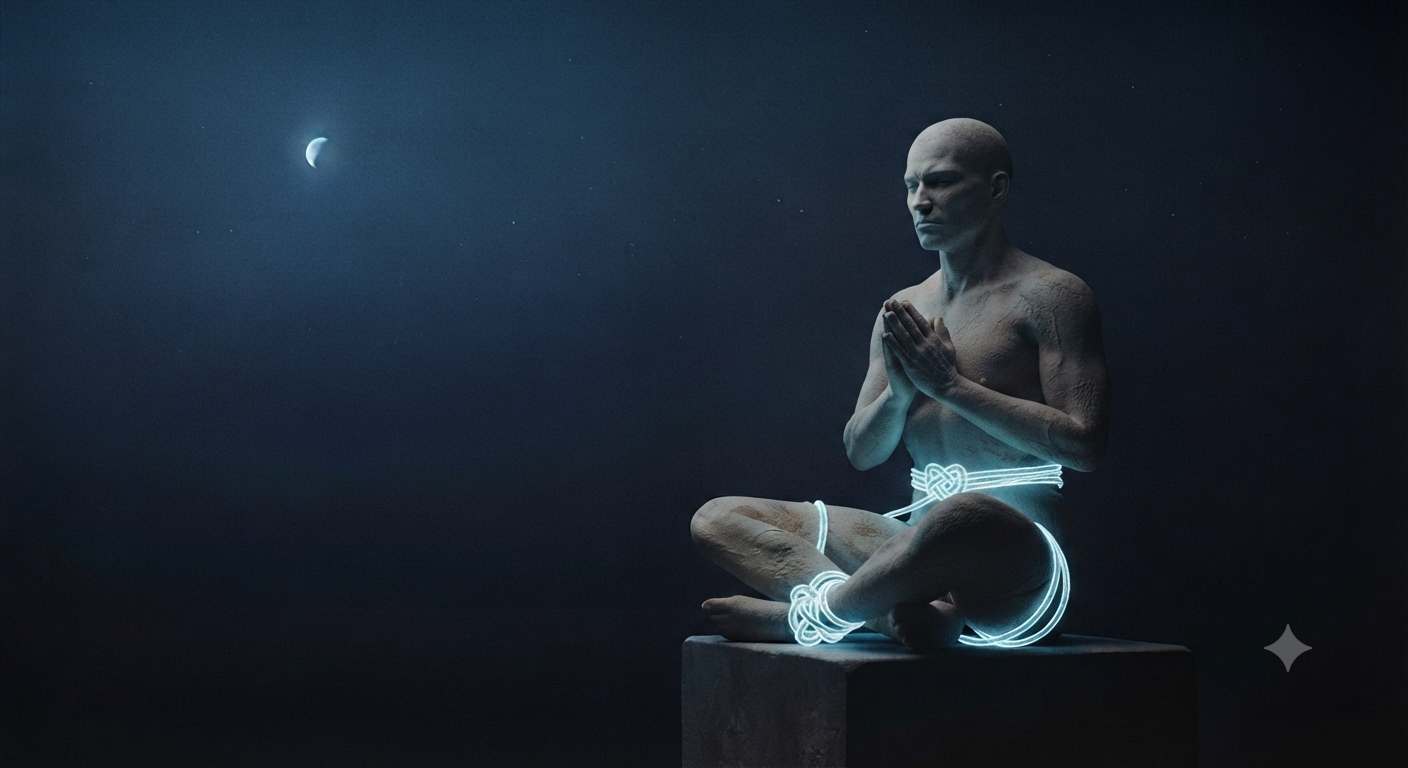
The smallest knots hold the greatest truths
The Sudden Leap Into Renunciation
He was an MBA, a rising sales manager in consumer electronics. Everything seemed to be going well—targets met, promotions earned, the hum of success in corporate corridors. Yet beneath the surface, the thought that he could not spend the rest of his life selling fridges and fans troubled him, always. One day, it became unbearable, and he quit.
Straight from the office, he boarded a train to Varanasi. On the riverfront, under the vast sky, he peeled off his suit and then the rest of his clothes, one by one, in a deliberate shedding. The night air touched his bare skin as he smeared his body with ash, marking the end of one life and the beginning of another. Thus, he stepped into renunciation.
Years later, when acclaimed author William Dalrymple met him and recorded his story for his book Nine Lives: In Search of the Sacred in Modern India, the MBA sanyasi who goes by the name Ajay Kumar Jha spoke without hesitation: his decision had been sudden, radical, and irreversible. And yet, he insisted, he had never regretted it. Not even once.
Where My Renunciation Ends
Reflecting on Ajay’s journey, I wondered if I could do something similar. Could I walk to the nearest river, peel off my worldly garments one by one, cover myself in ash, and wander into the wilderness? In theory, yes. In practice, I discovered my limits. While I could probably discard most of my clothes at this stage in my life, I would have to cling to my shorts. I realised this was the limit I dared to venture to. My detachment doesn’t extend beyond that.
This is a comical yet profound revelation: I find myself tied to samsara not so much by valuable possessions, but by the strings of my shorts. Those cotton strings prevent me from leaping into absolute freedom. The truth is that we are not always bound by big-value items. Small, invisible threads—habits, comforts, and trivial securities—keep us tethered.
The Invisible Threads
Desire, as Buddha taught us, is the root of all suffering, and if we look closely, those desires are often embarrassingly small. A cup of morning tea with the daily newspaper, a favourite chair, a cosy corner, or a pair of shorts—all turn precious and unavoidable in inscrutable ways. The Stoics warned for centuries that freedom is not just about owning less but about needing less. Mary Ellen Edmunds puts it succinctly: “Wanting less is a better blessing than having more.” But the key lies not in the saying, but in the doing. Notice the invisible threads and loosen them, one by one.
On a serious note, the focus is not on the shorts and the strings that attach them. It is about the attachment itself. The journey from shorts to sannyasa is not short at all; rather, it is long, winding, and filled with many pulls back from countless strings. Until I cut all those strings, I remain in samsara—a householder philosopher with one foot in renunciation and the other bound in many knots.
Renunciation Without Ashes
And so, until I can let go of that last garment, I remain here—half amused, half resigned—learning that enlightenment is not always found on mountains or amidst ashes. Sometimes, it begins with shorts. Renunciation is not a single leap into ash and riverside air—it is the daily practice of wanting less, until wanting itself dissolves.
I also realise that the call to total renunciation is not for everyone. It is meant for those few who are especially called to that path. But everyone can cultivate a sense of detachment—a freedom from being bound by material possessions. I would be happy to remain in that state where my decisions in life are not dictated by what I possess, nor by the fear of what I may lose. To enjoy what I have without being possessed by it—that, to me, is a more attainable and meaningful form of renunciation.


Got thoughts? Please share them below.