
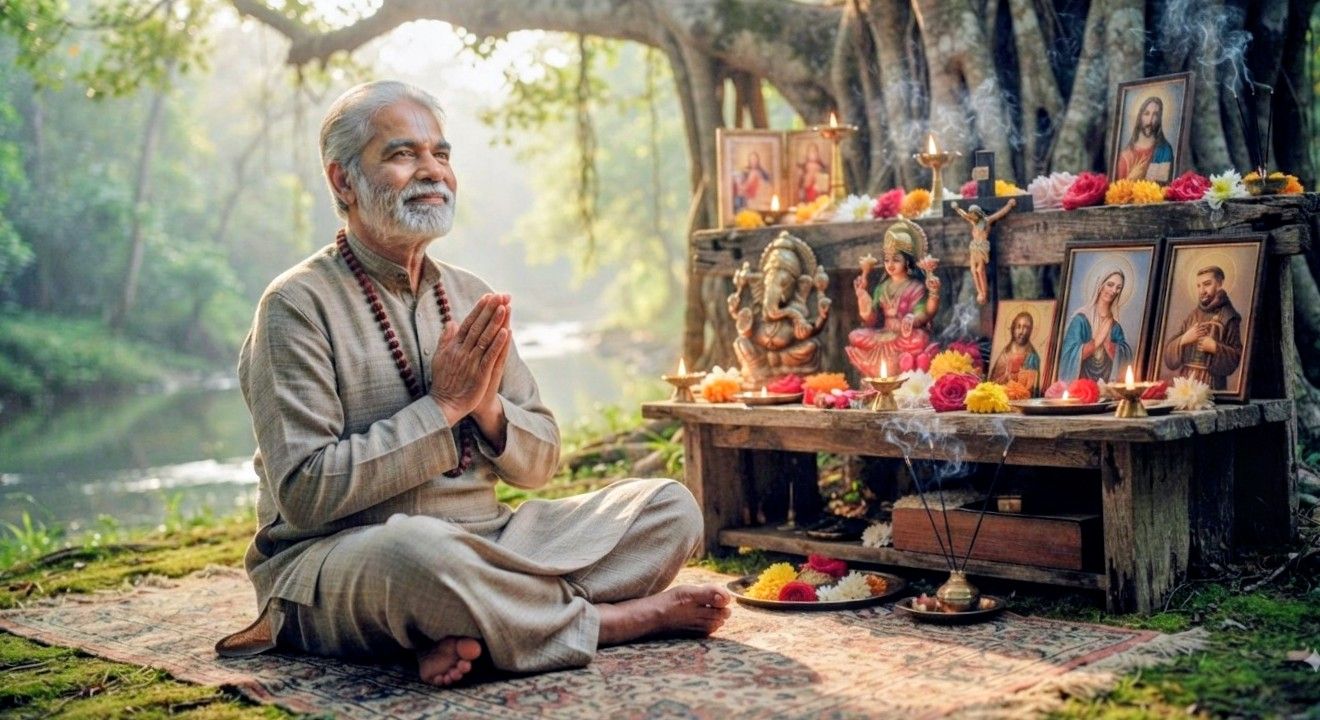
Beyond idols, into the soul’s sanctum.
The Mind That Makes Things Holy
Sacredness is not something that exists “out there.” A stone in a temple or a statue in a church is not inherently sacred. At its core, it is simply a piece of rock or clay shaped into an artefact. Sanctity does not lie within the material itself; human consciousness projects sacredness onto it. Just as beauty resides in the eye of the beholder, sacredness lives in the worshipper’s mind.
Devotion and belief transform an ordinary object into something sacred. In this sense, the devotee creates his own concept of God. Yet despite the vast spiritual possibilities, most of us remain bound by conditioning—our upbringing and early indoctrination—and locked into conventional forms of worship.
At best, a statue or idol serves as a focal point. It is a medium that helps direct attention toward inner sacredness. A truly evolved mind transcends these material limitations and carries sacredness within. At that stage, one begins to perceive the sacred everywhere—in a blade of grass bending to the wind, in flowers opening to the sun, in rain that cleanses, in moonlight that whispers silence.
Everything becomes sacred. Yet the most sacred of all is the person standing right next to you. The divine spark within him is the same as the one within you. Once this realisation dawns, external statues and idols lose their necessity, and worship transforms into compassion.
Where Mystics Meet
This intrinsic sacredness—untangled from man-made constructs—is the ultimate reality. The rest are illusions. Here, Christian mystics, Western transcendentalists, and Advaita Vedanta converge. This is what Meister Eckhart meant when he spoke of finding God in the “ground of the soul”.
Sacredness is not a property of objects but a mode of perception. It is the awakened gaze that sees unity beneath diversity, permanence beneath change. The Upanishads declare tat tvam asi—“thou art that”—reminding us that the divine is not distant but immanent. The Sufi mystics echo this when they say, “Wherever you turn, there is the face of God.”
To live in this awareness is to dissolve the boundary between the sacred and the profane. Washing dishes, walking in the rain, speaking to a stranger—all become acts of reverence. Sacredness ceases to be confined to ritual and becomes the rhythm of daily life.
Ultimately, sacredness is the recognition of interconnectedness: that the breath sustaining me is the same breath moving through the trees, the rivers, and the person beside me. To honour this truth is to live compassionately, without expectation of reward, seeing every moment as godly and every encounter as prayer.
Got thoughts? Please share them below.